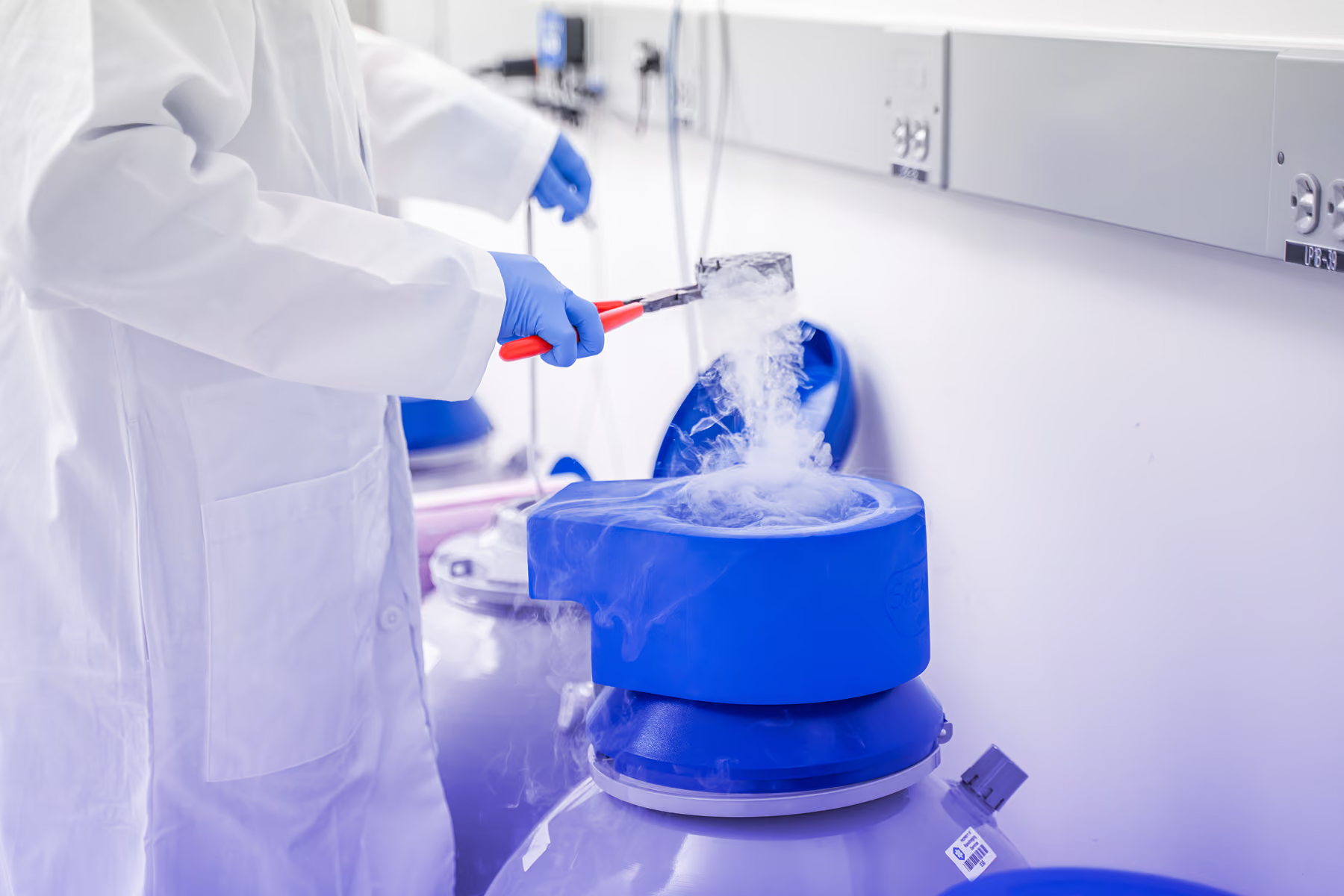

Kinetic, affinity, and stability data to move confidently into SAR, lead optimization, and developability decisions.
Understanding structure is only half the story. TrueCourse's biophysical characterization services measure how your molecules interact, bind, and hold up under stress, giving you the kinetic, affinity, and stability data needed to move confidently into SAR, lead optimization, and developability decisions.
Binding & Affinity
Precise, quantitative measurement of how your molecules bind, including kinetics, affinity, and stoichiometry.
Surface Plasmon Resonance (SPR)
Surface plasmon resonance is a gold-standard, label-free optical technique for measuring real-time biomolecular interactions. By detecting changes in refractive index at a sensor surface, SPR delivers precise kinetic and affinity data for protein-protein, protein-small molecule, protein-antibody, and other binding pairs.
What We Measure
- Association rate constant (k_on)
- Dissociation rate constant (k_off)
- Equilibrium dissociation constant (K_D)
- Binding stoichiometry
Advantages
- Label-free, real-time measurement with no fluorescent or radioactive tags
- Broad affinity range detection, from pM to µM
- Minimal sample consumption
- Results compatible with downstream SAR and lead optimization decisions
Bio-Layer Interferometry (BLI)
Bio-layer interferometry is a label-free, fiber optic biosensor technology that measures biomolecular interactions in real time. It works by analyzing interference patterns of white light reflected from two surfaces: a layer of immobilized protein on the biosensor tip and an internal reference layer. Shifts in that interference pattern correspond directly to changes in the number of molecules bound to the tip.
What We Measure
- Association rate constant (k_on)
- Dissociation rate constant (k_off)
- Equilibrium dissociation constant (K_D)
Advantages
- High-throughput format with parallel measurements across multiple channels
- Compatible with complex matrices, including lysates, serum, and conditioned media
- No microfluidics required, reducing sample volume and simplifying setup
SPR vs BLI at a Glance
| SPR | BLI | |
| Setup | Sensor chip + microfluidics | Disposable tips dipped in wells |
| Sensitivity | Detects small mass changes | Better for larger analytes |
| Speed | Requires fluidic calibration | Faster, simpler workflow |
| Samples | Purified | Complex or partially purified |
| Best for | Small-molecule programs | Protein-protein, antibody-antigen, biologic ranking |
Our Approach
- Collaborative from the start: assay strategy, immobilization optimization, concentration ranges, and interpretation
- Target turnaround: 1-2 weeks
- Dedicated biophysics team with deep SPR and BLI expertise
Integrated with Gene-to-Structure
Cryo-EM works best when the complex being imaged is stable and fully occupied. Binding assessment is an important go/no-go checkpoint before committing to structural studies. For clients in our gene-to-structure pipeline, SPR and BLI close that critical gap.
Stability
Data on how your protein holds up under thermal and formulation stress, supporting formulation development, comparability, and candidate selection.
Differential Scanning Fluorimetry (DSF)
Differential scanning fluorimetry, also known as thermal shift assay (TSA), measures protein thermal stability in real time, giving you a melting temperature (Tm) that reflects how well a protein resists unfolding under a given condition. It's widely used in structural biology and drug discovery to guide formulation development, compare protein variants, and support candidate selection.
Applications
- Determination of protein stability
- Optimization of protein formulation
- Comparative studies of protein variants or mutants
- Evaluation of ligand binding
- Analysis of protein-protein interactions
Advantages
- Plate-based format supports rapid screening across buffers, formulations, and conditions
- Low sample consumption
- No surface immobilization required, unlike SPR or BLI
- Straightforward readout for stability ranking and comparability studies