
Detailed, automated analysis of cryo-TEM images provides insights into payload location and density, lamellarity analysis, antigen distribution, and virus maturation state.
When nanoparticles are designed to carry specific payloads, understanding how the payload is distributed within the nanoparticle structure is crucial for optimizing their properties and applications. Determination of the loaded/unloaded ratios for nanocarriers is a critical measure of how effectively the delivery system can hold and protect the drug until it reaches its target site. Besides being unable to provide therapeutic benefit, empty nanocarriers also have the potential to increase unwanted immune responses.
Gene
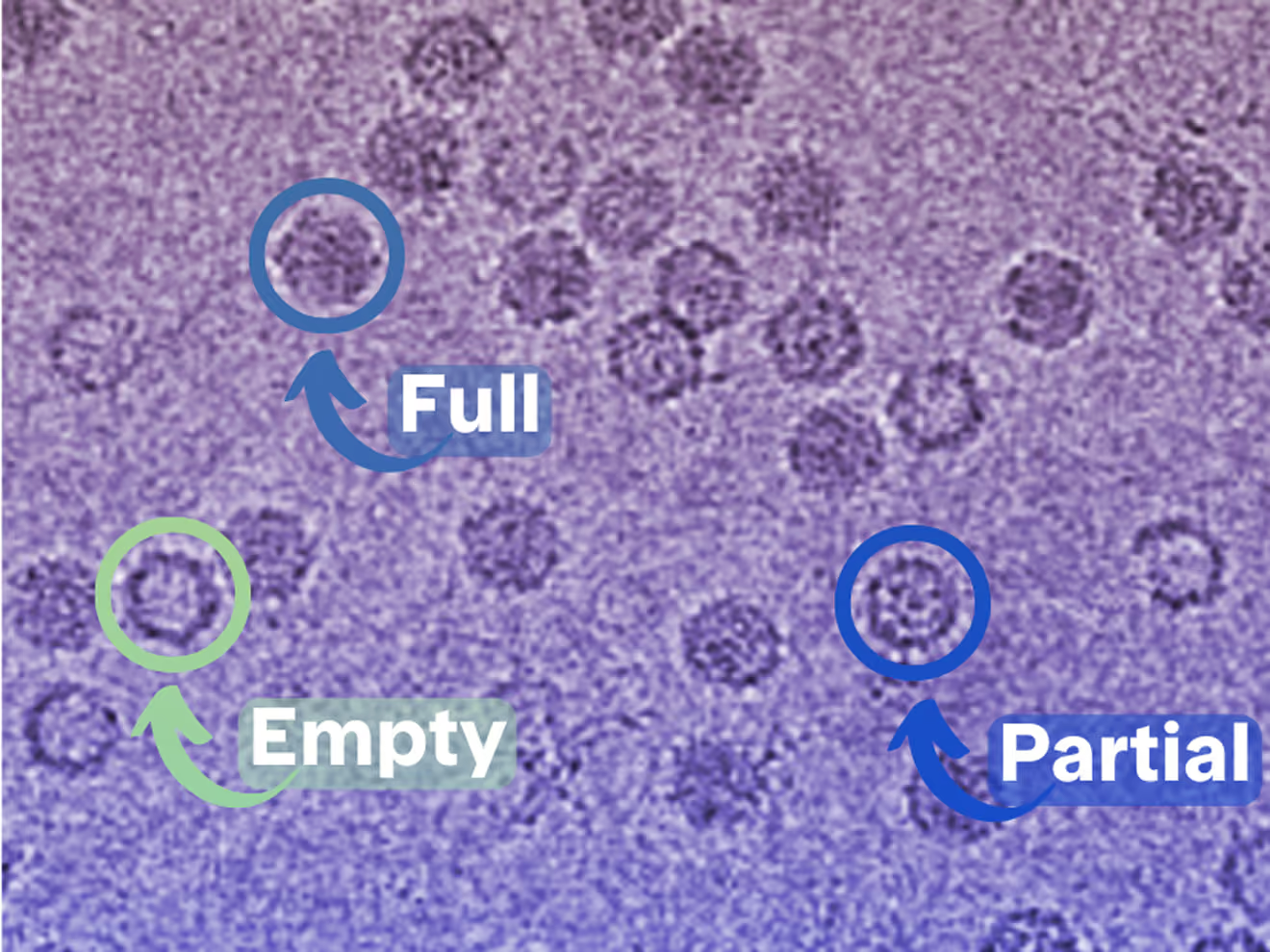
The full/empty/partially full ratio of capsids is one of the most important critical quality attributes (CQAs) to characterize, as the fraction carrying the intended genome versus those that are empty, partially filled, or overfull directly affects the safety, efficacy, and immunogenicity of the product.
Distribution of cargo among LNPs has important implications for the dosage, efficacy, and safety of a therapeutic. Uneven payload distribution may lead to higher than necessary dosage of components such as PEG-lipids, while also making it difficult to predict the amount of drug that will reach target cells.
- Full/empty/partial capsid ratio analysis of AAV
- Full/empty of adenovirus or bacteriophages
- Nucleic acid payload distribution in lipid nanoparticles
- Encapsulation efficiency of gene payloads
Drug
Liposomes are widely used for drug delivery, but their heterogeneity in size, lamellarity, and payload loading creates challenges for characterization. Only cryo-TEM provides data on morphology, lamellarity, size distribution, and payload in just one study. Cryo-TEM imaging and automated analysis delivers powerful visualization that goes beyond bulk measurements, enabling per-particle insights into drug delivery payloads.
A single cryo-TEM imaging study can visualize individual particles in your formulation and simultaneously provide information on particle size, morphology, payload encapsulation, and structural integrity, all with only ~50μl of sample.
Liposomal drug products, such as liposomal doxorubicin, depend on consistent payload encapsulation to control drug release and minimize toxicity. Cryo-TEM per-particle analysis reveals encapsulation efficiency and distribution across the population, information that bulk methods cannot provide.
What We Analyze
Automated particle classification analysis of cryo-TEM images allows a deeper understanding of particle populations:
- Percentage of blebbed particles in LNP formulations
- Prevalence of uni- and multi-lamellar, multicompartmental, and multivesicular liposomal particles
- Spatial distribution of antigens on virus or VLP particle surface
- How drug and nucleic acid payloads are distributed within formulations
- Presence of targeting moieties on LNP surface
Lamellarity Analysis
Lamellarity refers to the various arrangements of lipid bilayer within a particle, which is an important factor in determining the effectiveness of liposomes and lipid nanoparticles (LNPs) as delivery vehicles. Similar to size, morphology, and encapsulation state, lamellarity is a critical attribute that can affect bioavailability, stability, and therapeutic outcome.
Cryo-TEM imaging evaluates lamellarity in both liposomes and LNPs, differentiating between unilamellar, multilamellar, multicompartmental (or "blebbing" in LNPs), and multivesicular particles.
Antigen Distribution
Self-assembling nanoparticles can display numerous foreign antigens on their surface. Characterizing the antigen spatial distribution on the nanoparticle surface using cryo-TEM classifies particles as densely decorated, sparsely decorated, or no antigen decorated, helping to optimize nanoparticle-based vaccine design.