SPR/BLI Binding Services: Quantitative Binding Data On Demand
Before a drug candidate advances, researchers often need to determine whether a molecule binds its target, how rapidly the interaction forms, how rapidly it dissociates, and how tightly the partners interact. These measurements can inform compound selection and help assess whether a complex is suitable for downstream structural work.
TrueCourse provides surface plasmon resonance (SPR) and bio-layer interferometry (BLI) binding studies for teams that need quantitative data without maintaining both platforms in house. Method selection depends on the molecule type, the study question, the sample, and the program stage. In some programs, both methods may be useful.
SPR/BLI Analytical Services
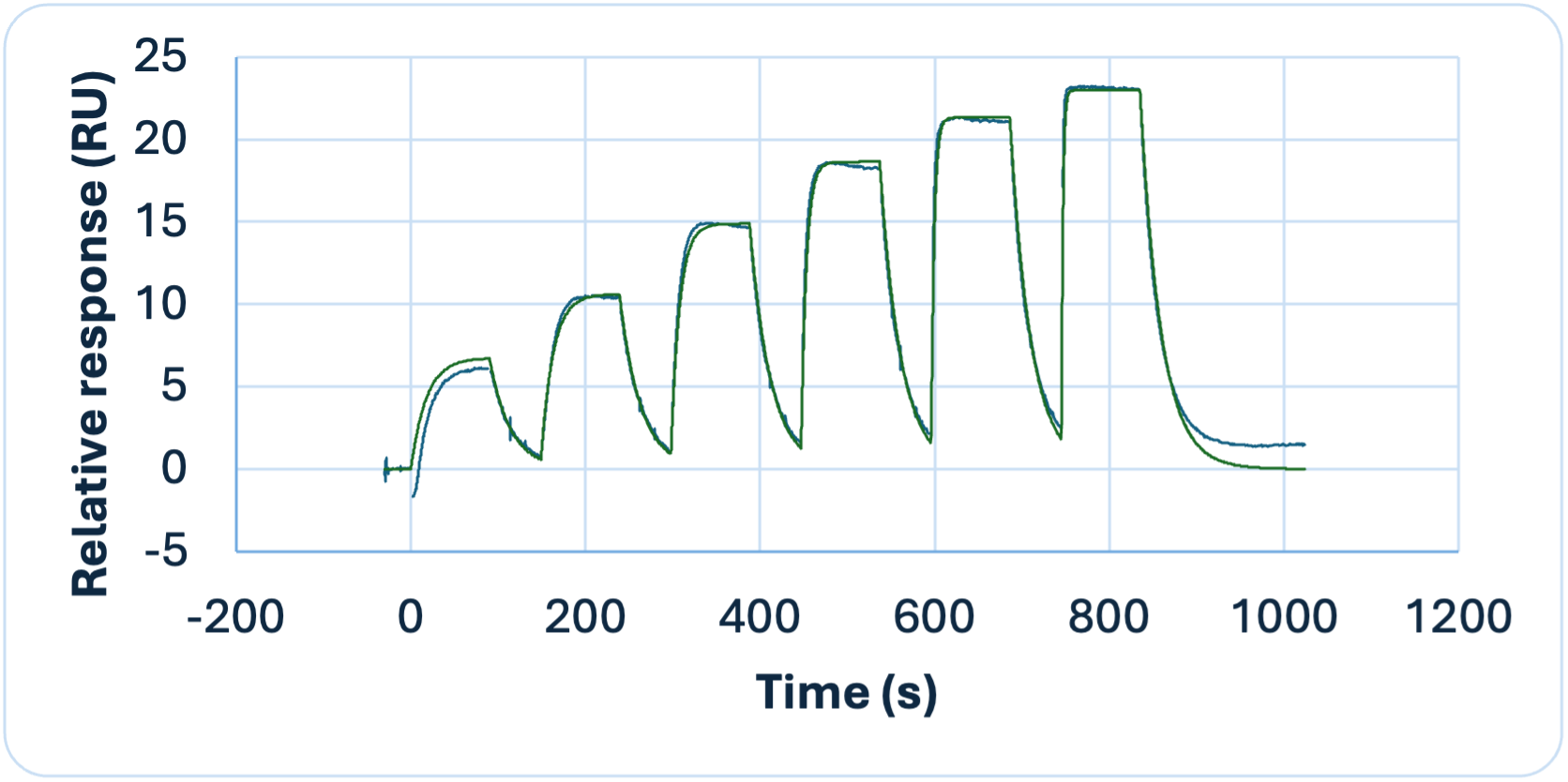
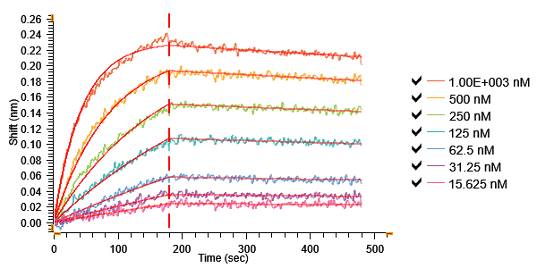
SPR and BLI are label-free biophysical methods that monitor binding interactions in real time [1, 2]. Both can be used to estimate three parameters that are central to kinetic interpretation:
- Association rate (kon), which describes how quickly an interaction forms.
- Dissociation rate (koff), which describes how quickly the bound complex separates.
- Equilibrium affinity (KD), which relates the association and dissociation behavior to binding strength.
Together, these measurements describe whether binding occurs, how quickly the interaction changes, and how long the partners remain associated under the study conditions.
What SPR and BLI measure
In SPR, a target is immobilized on a sensor chip and the candidate molecule flows across the surface in a microfluidic system. Binding changes the refractive index near the chip surface, producing a sensorgram in real time [1]. Sensitivity to small mass changes can make the method useful for small-molecule programs when the surface chemistry and assay design are appropriate.
In BLI, disposable biosensor tips are dipped into wells containing the analyte. Binding changes the optical thickness at the tip, shifts an interference pattern, and generates a real-time signal. The fluidics-free format can simplify setup and can accommodate complex or partially purified samples in suitable assay designs [2]. Practical applications include protein-protein interactions, antibody-antigen binding, and kinetic ranking of biologic candidates [2, 4].
SPR/BLI Assay Services for Different Molecule Types
Method selection should be based on the interaction and the decision the data must support. SPR may be a practical choice when small mass changes are important to detect. BLI may be a practical choice for protein-protein or antibody-antigen studies, for higher-throughput kinetic ranking, or when fluidics-free setup is useful. A combined strategy may help when orthogonal evidence is valuable or when different study stages place different demands on the assay.
SPR vs. BLI: How the Methods Compare
Neither method is universally preferable. The useful choice depends on the molecule, sample, study question, throughput needs, and program stage.
Applications of BLI in Drug Discovery
BLI can support protein-protein interaction analysis, antibody-antigen binding, and kinetic ranking of biologic candidates [2, 4]. Its disposable tip format and fluidics-free setup may also be useful when samples are complex or only partially purified. The suitability of a BLI design should be assessed against the analyte, binding partner, concentration range, immobilization strategy, matrix, kinetic behavior, and decision the study must support [3].
When SPR may be a practical fit
SPR can be useful when small mass changes need to be detected, including many small-molecule binding programs. The sensor surface, immobilization approach, concentration range, controls, mass transport, and kinetic model should be appropriate for the interaction being studied [1].
How TrueCourse Approaches SPR and BLI Binding Studies
Assay strategy, immobilization, and interpretation
TrueCourse begins with the study question and works collaboratively on assay strategy, immobilization optimization, concentration ranges, and interpretation. The objective is to design an experiment that addresses the project decision rather than to treat sample submission as a stand-alone instrument run.
A target turnaround of one to two weeks
TrueCourse targets a turnaround of one to two weeks, supported by a dedicated biophysics team with SPR and BLI expertise. Actual timing should be confirmed for each project because assay setup, sample readiness, and experimental scope may affect the schedule.
Binding Analysis in a Gene-to-Structure Workflow
Biophysical assessment before cryo-EM
For programs using an integrated Gene-to-Structure workflow, binding assessment can provide a go or no-go checkpoint before structural studies. The workflow can connect construct design and protein production with high-resolution cryo-EM structure determination.
Cryo-EM work generally benefits from a complex that is stable and fully occupied. If binding is weak, transient, or heterogeneous, the resulting structural data may be uninformative or difficult to interpret. SPR or BLI results can help a team evaluate the interaction before committing to the structural campaign, while recognizing that binding data are one part of the broader experimental assessment.
Frequently Asked Questions
What are SPR/BLI analytical services?
SPR/BLI analytical services use surface plasmon resonance, bio-layer interferometry, or both to monitor binding in real time and estimate kinetic parameters such as kon, koff, and KD. The service design can include assay strategy, immobilization optimization, concentration planning, data collection, and interpretation.
What is the difference between SPR and BLI?
SPR detects binding through changes in refractive index at a sensor-chip surface and commonly uses a microfluidic flow system. BLI detects changes in optical thickness at a disposable biosensor tip dipped into sample wells. The useful method depends on the interaction, sample, study question, and program stage.
When should I choose SPR vs. BLI?
SPR may be a practical fit when detecting small mass changes is important, including many small-molecule studies. BLI may be a practical fit for protein-protein or antibody-antigen binding, biologic-candidate ranking, complex or partially purified samples, or projects that benefit from a fluidics-free format. Some programs may use both methods.
What are the applications of BLI in drug discovery?
BLI can support protein-protein interaction analysis, antibody-antigen binding, and kinetic ranking of biologic candidates. It can also be considered when its disposable tip format and compatibility with complex or partially purified samples suit the study design.
Can SPR and BLI measure kon, koff, and KD?
Both methods can generate real-time binding data used to estimate the association rate, dissociation rate, and equilibrium affinity. The reliability of those estimates depends on the assay design, data quality, concentration series, and appropriateness of the binding model.
What is SPR protein binding?
SPR protein binding refers to monitoring an interaction at a sensor-chip surface through binding-associated refractive-index changes. One interaction partner is immobilized, and the other is passed across the surface so association and dissociation can be observed in real time.
Can SPR and BLI support cryo-EM programs?
They can provide binding and kinetic evidence before a structural campaign. Binding assessment can serve as a practical checkpoint before high-resolution cryo-EM structure determination, particularly when complex stability or occupancy needs evaluation.
Discuss an SPR/BLI Binding Study
If your program needs binding data, TrueCourse can help evaluate whether SPR, BLI, or a combined approach is appropriate for the molecule, sample, and decision at hand. Contact TrueCourse to discuss the study question, available material, and proposed scope.
[ CTA button ]
Peer-reviewed references cited in the draft
[1] Douzi, B. (2017). Protein-Protein Interactions: Surface Plasmon Resonance. Methods in Molecular Biology, 1615, 257-275. https://doi.org/10.1007/978-1-4939-7033-9_21
[2] Concepcion, J., Witte, K., Wartchow, C., et al. (2009). Label-free detection of biomolecular interactions using BioLayer interferometry for kinetic characterization. Combinatorial Chemistry & High Throughput Screening, 12(8), 791-800. https://doi.org/10.2174/138620709789104915
[3] Weeramange, C. J., Fairlamb, M. S., Singh, D., Fenton, A. W., & Swint-Kruse, L. (2020). The strengths and limitations of using biolayer interferometry to monitor equilibrium titrations of biomolecules. Protein Science, 29(4), 1018-1034. https://doi.org/10.1002/pro.3827
[4] Bates, T. A., Gurmessa, S. K., Weinstein, J. B., et al. (2025). Biolayer interferometry for measuring the kinetics of protein-protein interactions and nanobody binding. Nature Protocols, 20(4), 861-883. https://doi.org/10.1038/s41596-024-01079-8
.png)
.png)
.png)